No Coding Required: How Marketers Build AI Tools


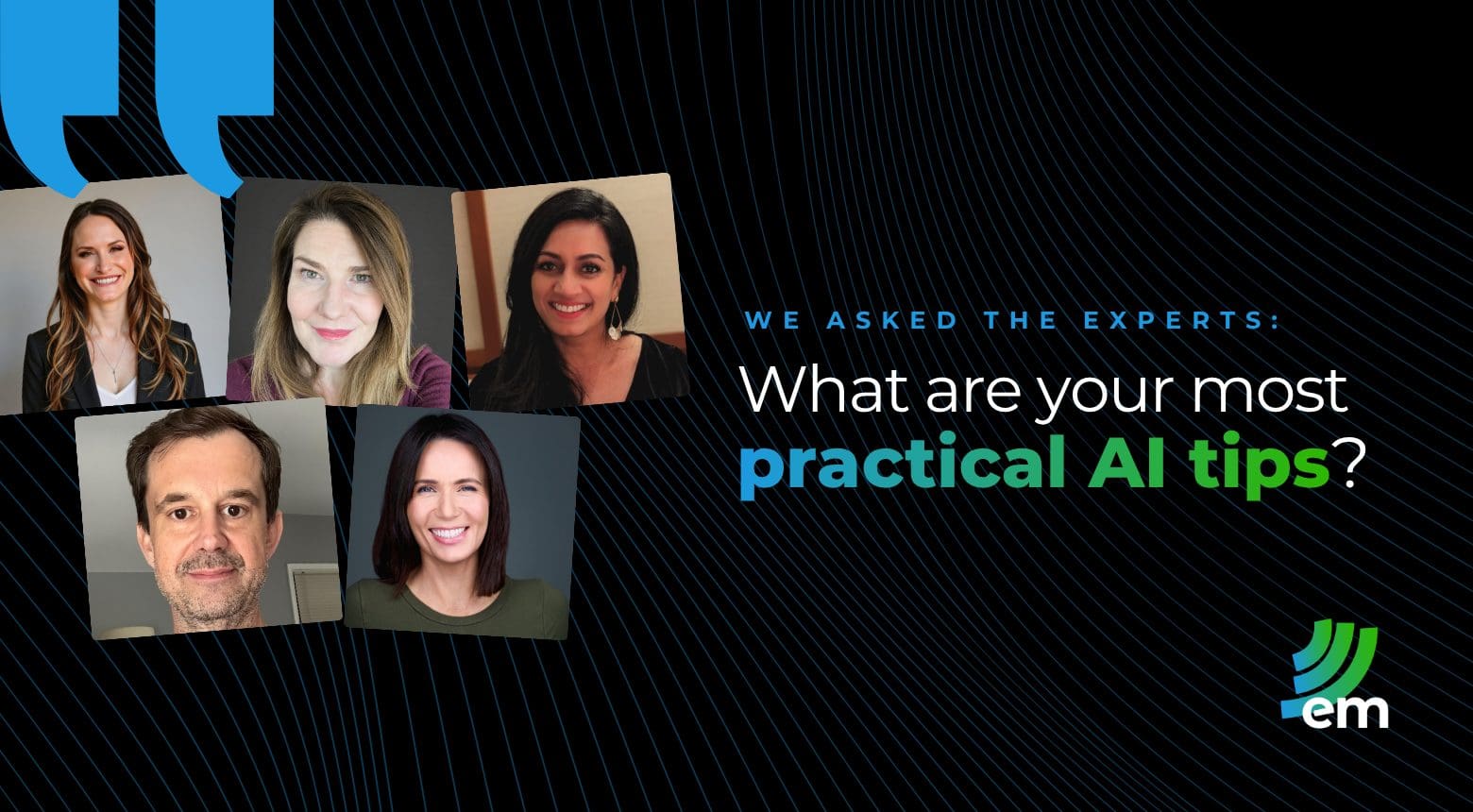
We asked EM Community experts how they are putting AI to work in their own practice. In this final installment of our series, we look at Marketers Who Built AI Tools. None of the five consultants below have a formal engineering background. All five shipped real, working software: a marketing assistant, a video generator, a full website, a custom audit tool, and a content system built for AI agents.
In an AI Agent-Led Marketing World, Human Creativity Is More Important than Ever
Delyn Simons is a fractional VP of product marketing who was hired by mid-market clients in different verticals to uncover why some products were being penalized by AI agents sharing stale, outdated sources of information – including release notes published over three years earlier. While products from both clients had evolved into full-stack, no-code/low-code platforms, AI agents kept describing them as coding tools for a technical front-end audience. This not only was limiting how prospects found and evaluated these products for purchase consideration, but also was artificially restricting the total addressable market and value of these clients into the future.
Delyn built what she calls an AI extraction plan to rebuild accuracy and credibility in their new space. This consisted of refreshed landing pages backed by AI-assisted keyword research, as well as site speed and accessibility audits. To increase her own productivity with a globally-distributed team, she used AI to summarize meetings and decisions so she could synthesize that information faster. She describes her broader consulting practice as agent-assisted marketing, where AI does heavy lifting of day-to-day tasks so as a marketer, she can focus on ideation and creativity for her clients.
A Localized Marketing Assistant Built in 48 Hours
Karolina Potterton is the principal marketing consultant and fractional CMO at Fireheart Marketing, her own consulting practice. Previously, as VP of Marketing at Guidepost Global, a Montessori school network spanning the United States and Asia-Pacific, she built a local marketing assistant in Claude Code despite having no coding background. The tool generates a 30/60/90-day marketing plan for each campus and surfaces the existing resources that support it; she completed the first working version within 48 hours and later added a Gemini-powered chatbot so each school could get answers based on its own data.
Separately, when a CRM migration left her team without adequate reporting, she built a lead-funnel and UTM dashboard in Claude to replace the reporting that Power BI and Microsoft Dynamics had not provided. Her advice for a nervous, non-technical reader is to start any AI project with a project plan, then break it into small, manageable steps.
Quick Draft Video Generation to Test What Resonates
Josef Robey runs a consultancy called Storytelling Tech, advising creators, agencies, and executives on rapid video prototyping. He built VERP, an agentic tool that turns a written idea into a two-to-three-minute video in about ten minutes, using licensed B-roll footage rather than fully AI-generated video, for just a few dollars per video.
His framing is distinct from the other video use cases in this series. VERP isn’t built for final-polish production. It’s built for content experimentation, producing many cheap draft concepts so a team can learn what resonates before committing real budget to one direction.
A Full Website Prototype Built and Launched in a Week
Sherry Prescott-Willis is a non-technical marketer who prototyped a startup client’s entire website in Lovable in about a week. She brought the founder, head of business development, and technology officer into the tool together live to build a style guide and finish out their website. The $20,000 originally budgeted for a web developer got redirected into developing the product demo instead.
When using AI for a product launch or research evaluation, Sherry’s clearest caution is for people tempted to lean on AI output uncritically. Come up with your own thesis about a solution and have AI poke holes in the execution. In other words, use your human judgment and expertise.
Unlocking a Full Audit Service
Michael Gasiorek runs a marketing strategy and service agency called Truth Cartel. In this example, they built a custom AI skill in Claude for SEO and marketing audits as a largely automated lead magnet. Over several rounds, they iterated it to go from 60% accuracy to more than 90%. The system pulls clean third-party data from tools like Ahrefs rather than trusting AI’s own read of a site.
The tool unlocked a full-depth marketing and SEO audit as a new service offering to enhance their creative and storytelling expertise. Previously a painstaking, multi-week manual process, they now share the AI-powered audits as a free tool to help drive sales. Michael says AI is strong at synthesis and first drafts, but weak at final judgment and qualitative calls. It leaves space for human ingenuity.
Want This Kind of Thinking on Your Team?
EM Marketing’s experts know how to put AI to work on everyday marketing problems. Just as importantly, they know where their own judgment still has to lead. If your team needs that kind of thinking, on a project or full engagement basis, let’s talk about which of our consultants is the right fit for what you’re building next.
This is Part 4 of a four-part series. Catch up on Part 1: Strategy, Positioning & Research, Part 2: Demand Generation & Paid Media, and Part 3: Content, Creative & Editorial Quality.

Related
-
 | Damon Brennen
How I Went From Prompting to Producing
-
-
-
-
-
-
-
-
-
-
-
-
-
-
| Leilani Yau
Navigating Today’s Job Search with AI
-